Tuesday, 3 March 2015

Birds and Mammals - Ooty 2015

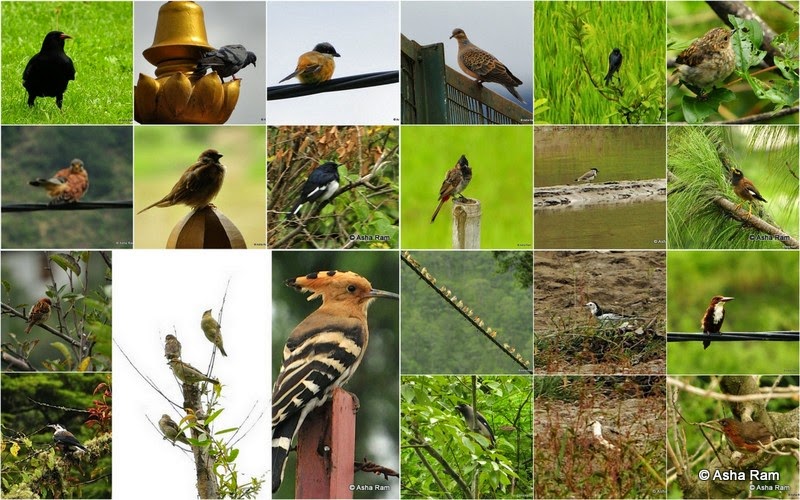
Birds at Ooty sighted during end of Feb and beginning of Mar 2015

We drove from Bangalore to Ooty via Mudumalai, and returned through Gudalur. Both route were amazing to sight animals and birds. The forests were dry; some trees were ready to flaunt tender leaves. While I was wondering if summer will be a dry one, rain showered!

As we drove, we sighted birds but couldn't stop to click photos. Beautiful peacock welcomed us at Mudumalai forest reserve. We saw deers, samba deers, Hanuman langurs, Nilgiri langurs, giant squirrels, and wild boars. We stopped at Pug Mark for lunch, and found out that they had sighted a tiger and a leopard during the morning safari. We were tempted to take the evening safari but then our destination was calling us.

At Ooty, we saw Common Mynas, Spotted Doves, and Red-Whiskered Bulbuls everywhere. The Mynas population seems to out-beat the population of Crows. The Bulbuls weren't shy to be near humans; they happily sang and socialized with their own kind.

The Botanical Garden, Fernhill, Cairn Hill, and a drive around Ooty are good places for birding. We didn't visit Doddabetta, which is excellent to see Nilgiri Pigeons. Cairn Hill has a lot of birds. We were happy to see the Nilgiri Pigeon in flight. We heard and saw several birds, but couldn't photograph them as they perched high and, at ground level, the thicket wasn't favorable to get clear photos of the birds. We watched mating pair of Giant Squirrels. Nilgiri Langurs sat high above the trees, and observed us keenly. Was a pleasant visit to Cairn Hill!

The list of birds that we saw/heard:

  1. Ashy Prinia
  2. Blackbird
  3. Black-Orange Flycatcher
  4. Pied Bushchat
  5. Hoopoe
  6. Lesser Yellow Nape
  7. Common Myna
  8. Nilgiri Robin
  9. Flowerpecker
  10. Canary Flycatcher
  11. Bushchat
  12. Heron
  13. Common Kestrel
  14. Red-Whiskered Bulbul
  15. Red-Vented Bulbul
  16. Peacock
  17. Bird of Prey (yet to ID)
  18. Cormorant
  19. Egret
  20. Common Crow
  21. White-Throated Fantail
  22. Oriental White Eye
  23. Greenish Warbler
  24. Sunbird
  25. Shrike
  26. Sparrow
  27. Drongo
  28. Indian Roller (Bandipur)
  29. White-Breasted Kingfisher
  30. Common Kingfisher
  31. Grey Francolin (Bandipur)
  32. Jungle Fowl (heard calls)
  33. Brahminy Kite (on Bandipur to Mysore road)
  34. Wagtail
  35. Jungle Babbler
  36. Spot-Billed Pelicans (Nanjangud-Mysore road)
  37. Black Kites (Mysore road)
  38. Laughing Dove
  39. Parakeet

Birds
List of mammals that we saw:

  1. Hanuman Langurs
  2. Nilgiri Langurs
  3. Wild Boars
  4. Spotted Deers
  5. Samba Deer
  6. Giant Squirrels
  7. Bonnet Macaque 

Mammals
For photos of flowers, see Colorful Flowers of Ooty.

Regards,
Asha

Thursday, 9 October 2014

Indian Grey Hornbill - Ocyceros Birostris

Was a pleasant surprise to spot the Indian Grey Hornbill at Jaipur (especially when not on a bird-watching tour)! During early morning, it was their call that made me search for the birds. There was a pair; they flew and hid among thick lush branches. Their heavy flight with the grey-black-white wings was worth watching. Quietly observed them till my neck hurt, and then moved away.

Indian Grey Hornbill at Jaipur
Regards,
Asha

Wednesday, 8 October 2014

Birds of Bhutan September 2014

During my visit to Bhutan, I managed to photograph a few birds. I couldn't photograph some birds or some of the photos aren't clear. There were several birds that only my eyes captured. I have video (no sufficient light) plus audio recording of chirping of birds. The last photo (on which copyright printed) is Rusty-cheeked Scimitar-Babbler; supposed to be rare to sight. Well, I'm happy that I have secret birding places to go back to, at Bhutan. 


Birds of Bhutan
The birds of Bhutan sighted during my visit are as follows:
  1. Red-Billed Chough
  2. House Crow
  3. Pigeon
  4. Grey-backed Shrike
  5. Oriental Turtle Dove
  6. White-capped Water Restart
  7. Drongo
  8. Black Kite
  9. House Swift
  10. Common Kestrel 
  11. Russet Sparrow
  12. Eurasian Tree Sparrow 
  13. Red-Vented Bulbul
  14. River Lapwing
  15. Common Myna
  16. Eurasian Hoopoe
  17. White Wagtail
  18. White-throated Kingfisher
  19. Grey Treepie
  20. Rufous Treepie
  21. Long-tailed Shrike
  22. Sandpiper
  23. Rusty-cheeked Scimitar-Babbler 
  24. Oriental Skylark/Yellow-browed Tit?
  25. Green-backed Tit
  26. Yellow Billed Blue Magpie 
  27. Spotted Dove

Regards,
Asha

Tuesday, 7 October 2014

Black-winged Stilt - Himantopus Himantopus


Early morning we went for a walk at the Jal Mahal lake, Jaipur. The sunrise was beautiful; the Jal Mahal looked splendid. The Black-winged Stilt were one of the birds that we saw at the lake. The two stilts were a little away from one another. After a while, they moved closer to each other, and moved in one direction. The entire scene was serene. Easy to recognize these birds with their characteristic Red/Pink legs and slender long beaks.
Black-winged stilts
Regards,
Asha

Sunday, 15 June 2014

White-browed Bulbul - Pycnonotus Luteolus

A friend and I went on a drive to Devrayanadurga on one of the Saturdays. Was fun to sight a lot of birds! One such bird was the White-browed Bulbul. As we descended the hill, we sighted this bird, sitting on a tree for a while. I mistook the bird to be Yellow-browed but my friend provided the bird's correct ID.

Wikipedia description helps in distinguishing between the White-browed and Yellow-browed bulbuls.

"This species is identifiable by the white supercilium, white crescent below the eye, and dark eyestripe and moustachial stripe. The vent is yellowish and there is some yellow on the chin and moustache. The throat is however largely whitish unlike in the similar looking and sounding Yellow-throated Bulbul which is found in rockier habitats. Three or four hair-like filoplumes are present on the nape."


White-browed bulbul
Regards,
Asha

Tuesday, 20 May 2014

Spot-billed Pelican - Pelecanus Philippensis

The Spot-billed Pelicans can be seen breeding and nesting at Kokkare Bellur village. The birds coexist with the villagers, and nest on trees in and around the village. The bird droppings are rich in phosphorus and potassium; good manure for the agricultural lands.

The season is during September-October to May-June. The village has sign boards indicating the direction to the parking lot. Pay a nominal amount to the caretaker. You will be flocked by young boys on their bi-cycles, promising to show you birds. They can pester you till you yield! Please kindly ignore them. You don't need a guide because, as you enter the village, you can see colonies of birds nesting on trees (fig, tamarind, and so on). The call of birds will direct you to the trees, if you are unable to sight them. You can freely roam around the village but ensure to respect privacy and culture. Do not harm the natural habitat. Do not, please, try to touch the birds or nest or eggs or even fallen chicks. Do NOT pay money to anyone!

The Karnataka Forest Department works with the villagers to protect birds visiting the village. The department provides a compensation (a fixed amount of money) for each tree that the birds use for nestling. This scheme is in place to compensate the loss of benefits from not harvesting tamarind (from trees) and the land below the trees.

For list of birds we sighted, see My eBird Checklist.


Regards,
Asha

Wednesday, 14 May 2014

Painted Stork - Mycteria Leucocephala

We've grown up seeing these birds at Ranganathittu bird sanctuary (at Mandya district, on way to Mysore). The season happens to be from November to June. We can also see this bird nesting at Kokkarebelluru. This is a small sleepy village; villagers protect the birds during nesting period. In fact, they have a protection area for the young ones that fall off the trees or those that are abandoned by parents. Will talk more about these two places later.

The Painted Stork is an amazingly beautiful bird; widespread resident in plains. The down-curved yellow bill, orange head, pink legs, long wings,white-black wings, and pink tertial feathers are distinctive of the bird. The juvenile is greyish-white and has greyish-brown feathers. The adult birds look stunning when in flight.

Painted Stock collecting nesting material
Adult Storks with chicks
Regards,
Asha